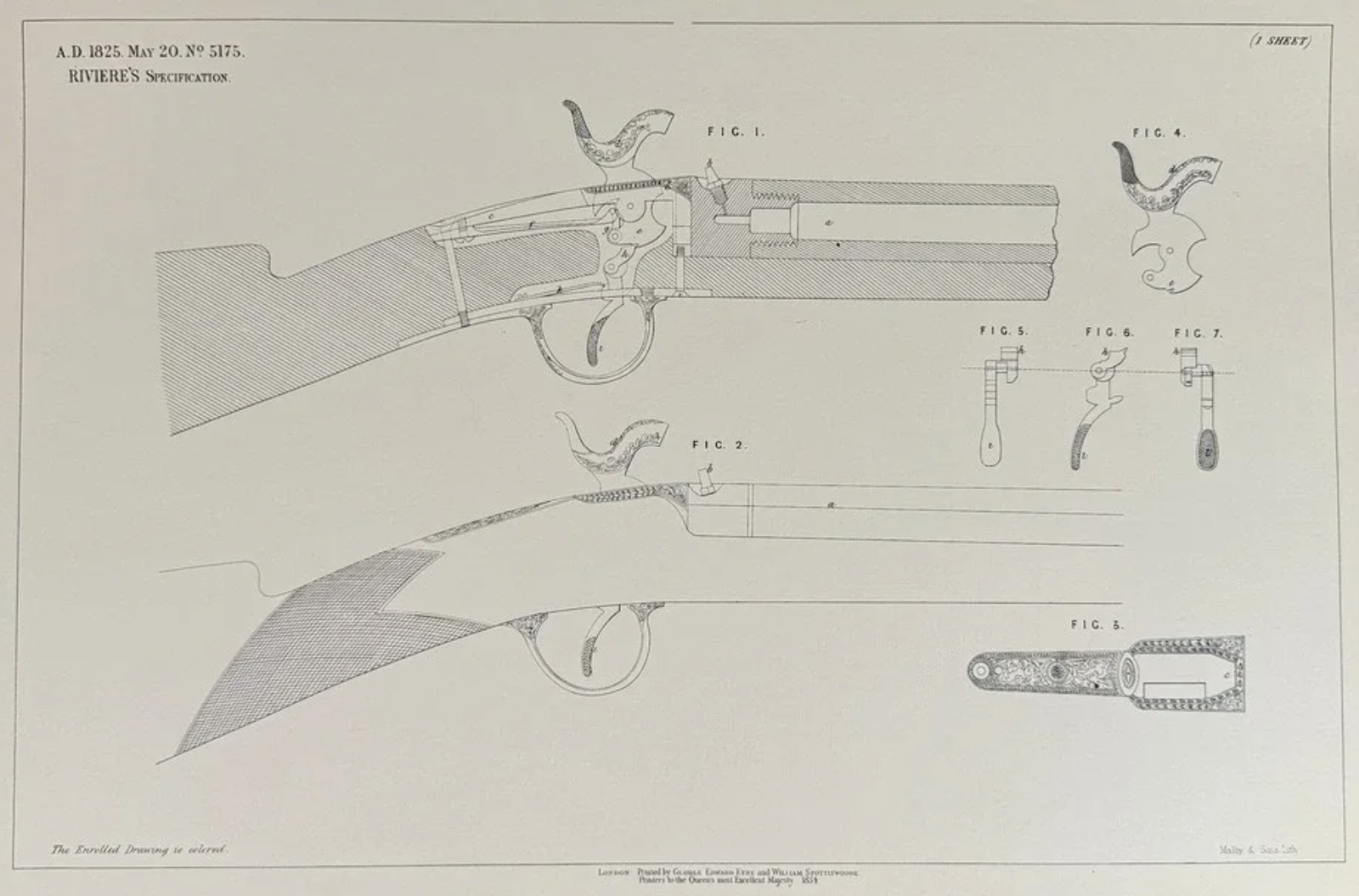
An examination of Isaac Riviere’s patented firearms reveals why collectors should reconsider familiar markings and production dates.
Numbers stamped on antique firearms can reveal important information about their manufacture. However, new research suggests that markings on certain British firearms have frequently been misidentified as serial numbers.
In February 2026, researcher Matthew Schneiderman published a study of firearms manufactured by London gunmaker Isaac Riviere. The report, available through the American Society of Arms Collectors (ASAC), examines Riviere’s unusual numbering practices.
Riviere received British patent No. 5175 on May 20, 1825, for an innovative box-lock firearm mechanism. He advertised the design as “the guns without locks,” referring to its unconventional construction.
Surviving examples of these firearms sometimes bear markings consisting of Riviere’s name, the word “Patent,” and an individual number.
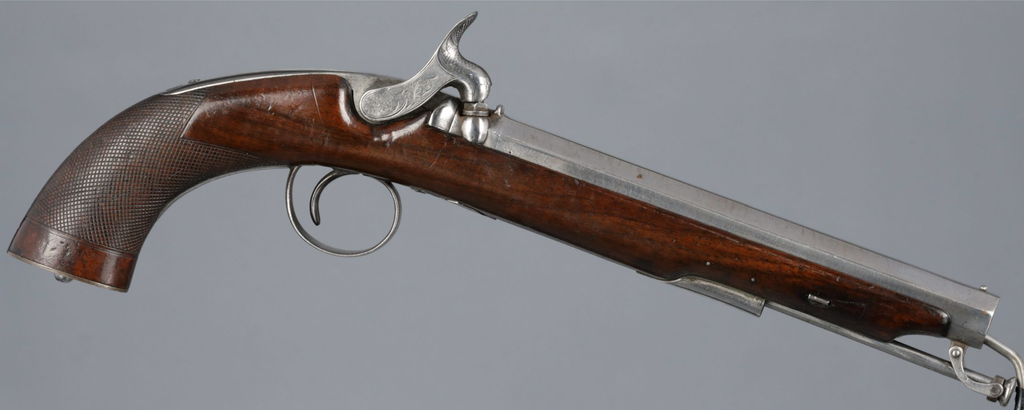
Collectors and auction houses have often described these markings as serial numbers. Schneiderman argues that they served an entirely different purpose.
His research indicates that Riviere numbered firearms incorporating his patented mechanism to track production under that patent. Other firearms bearing the Riviere name appear to lack comparable numbering.
This distinction matters because serial numbers and patent-tracking numbers do not necessarily provide the same information.
A manufacturer’s serial number can help establish production chronology and sometimes indicate how many firearms were manufactured. Patent-tracking numbers, however, may account for only those examples incorporating a particular patented feature.
Schneiderman also notes that paired Riviere firearms received consecutive patent-tracking numbers rather than sharing one number.
The study challenges another common assumption involving these firearms.
Auction and dealer descriptions frequently date Riviere’s patented designs to approximately 1825 or 1825–1830. Schneiderman cautions that these dates often reflect the patent’s issuance rather than documented manufacturing dates.
Without reliable production benchmarks, determining when individual examples were manufactured remains difficult.
For collectors, these findings demonstrate the limitations of relying exclusively on markings and traditional catalogue descriptions. Similar identification challenges arise in archaeological collections, where researchers use reference materials to identify historic firearms components.
A number stamped on an antique firearm may appear straightforward, but its original purpose can dramatically change how researchers interpret it.
The same applies to assumptions about rarity. A numbered example cannot automatically establish total production figures when the manufacturer also produced unnumbered firearms.
Schneiderman’s study identifies known examples and invites owners to contribute additional patent-tracking numbers.
Those contributions could help researchers better understand surviving Riviere firearms and potentially establish more accurate production patterns.
The complete report, Isaac Riviere Patent-Tracking Numbers (Sometimes Referred To Erroneously As “Serial Numbers”), Plus Background Information, is available through ASAC’s online research library.
For collectors examining rare British firearms, the study offers a reminder that identification requires more than reading the numbers stamped into the metal.