Tag: Firearms Research

  • New Research Challenges Serial Number Identification on Rare British Firearms

    New Research Challenges Serial Number Identification on Rare British Firearms

    An examination of Isaac Riviere’s patented firearms reveals why collectors should reconsider familiar markings and production dates.

    Numbers stamped on antique firearms can reveal important information about their manufacture. However, new research suggests that markings on certain British firearms have frequently been misidentified as serial numbers.

    In February 2026, researcher Matthew Schneiderman published a study of firearms manufactured by London gunmaker Isaac Riviere. The report, available through the American Society of Arms Collectors (ASAC), examines Riviere’s unusual numbering practices.

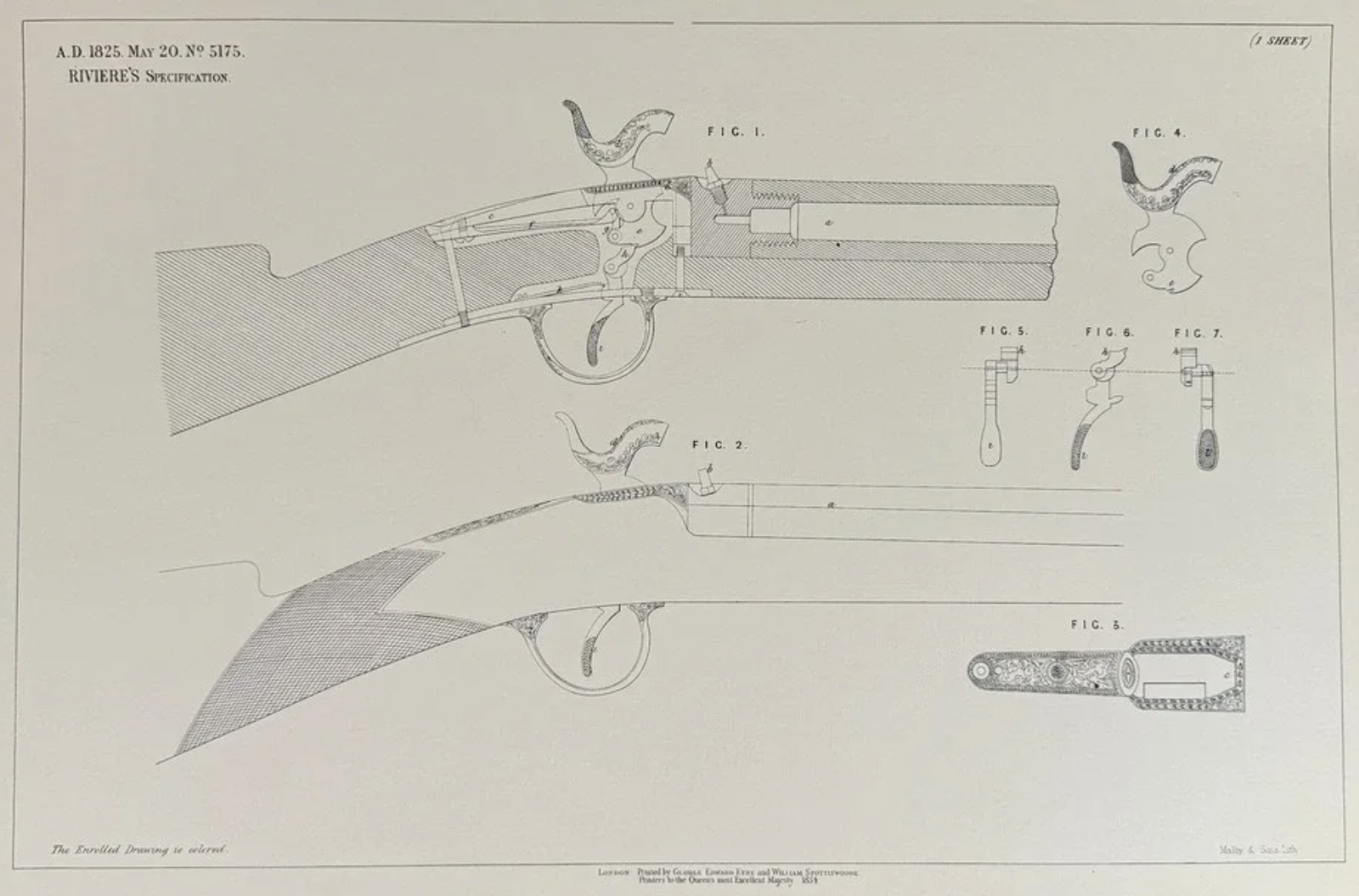
    Riviere received British patent No. 5175 on May 20, 1825, for an innovative box-lock firearm mechanism. He advertised the design as “the guns without locks,” referring to its unconventional construction.

    Surviving examples of these firearms sometimes bear markings consisting of Riviere’s name, the word “Patent,” and an individual number.
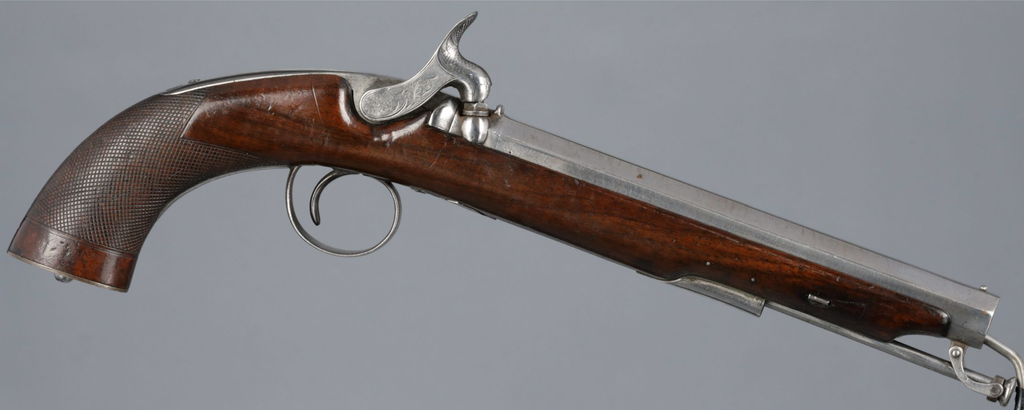
    Riviere Patent Percussion Pistol
    Riviere Patent Percussion Pistol (Rock Island Auction Company)

    Collectors and auction houses have often described these markings as serial numbers. Schneiderman argues that they served an entirely different purpose.

    His research indicates that Riviere numbered firearms incorporating his patented mechanism to track production under that patent. Other firearms bearing the Riviere name appear to lack comparable numbering.

    This distinction matters because serial numbers and patent-tracking numbers do not necessarily provide the same information.

    A manufacturer’s serial number can help establish production chronology and sometimes indicate how many firearms were manufactured. Patent-tracking numbers, however, may account for only those examples incorporating a particular patented feature.

    Schneiderman also notes that paired Riviere firearms received consecutive patent-tracking numbers rather than sharing one number.

    The study challenges another common assumption involving these firearms.

    Auction and dealer descriptions frequently date Riviere’s patented designs to approximately 1825 or 1825–1830. Schneiderman cautions that these dates often reflect the patent’s issuance rather than documented manufacturing dates.

    Without reliable production benchmarks, determining when individual examples were manufactured remains difficult.

    For collectors, these findings demonstrate the limitations of relying exclusively on markings and traditional catalogue descriptions. Similar identification challenges arise in archaeological collections, where researchers use reference materials to identify historic firearms components.

    A number stamped on an antique firearm may appear straightforward, but its original purpose can dramatically change how researchers interpret it.

    The same applies to assumptions about rarity. A numbered example cannot automatically establish total production figures when the manufacturer also produced unnumbered firearms.

    Schneiderman’s study identifies known examples and invites owners to contribute additional patent-tracking numbers.

    Those contributions could help researchers better understand surviving Riviere firearms and potentially establish more accurate production patterns.

    The complete report, Isaac Riviere Patent-Tracking Numbers (Sometimes Referred To Erroneously As “Serial Numbers”), Plus Background Information, is available through ASAC’s online research library.

    For collectors examining rare British firearms, the study offers a reminder that identification requires more than reading the numbers stamped into the metal.
  • Researchers Reconstruct Arms Historian’s Gun Lock Catalog

    Researchers Reconstruct Arms Historian’s Gun Lock Catalog

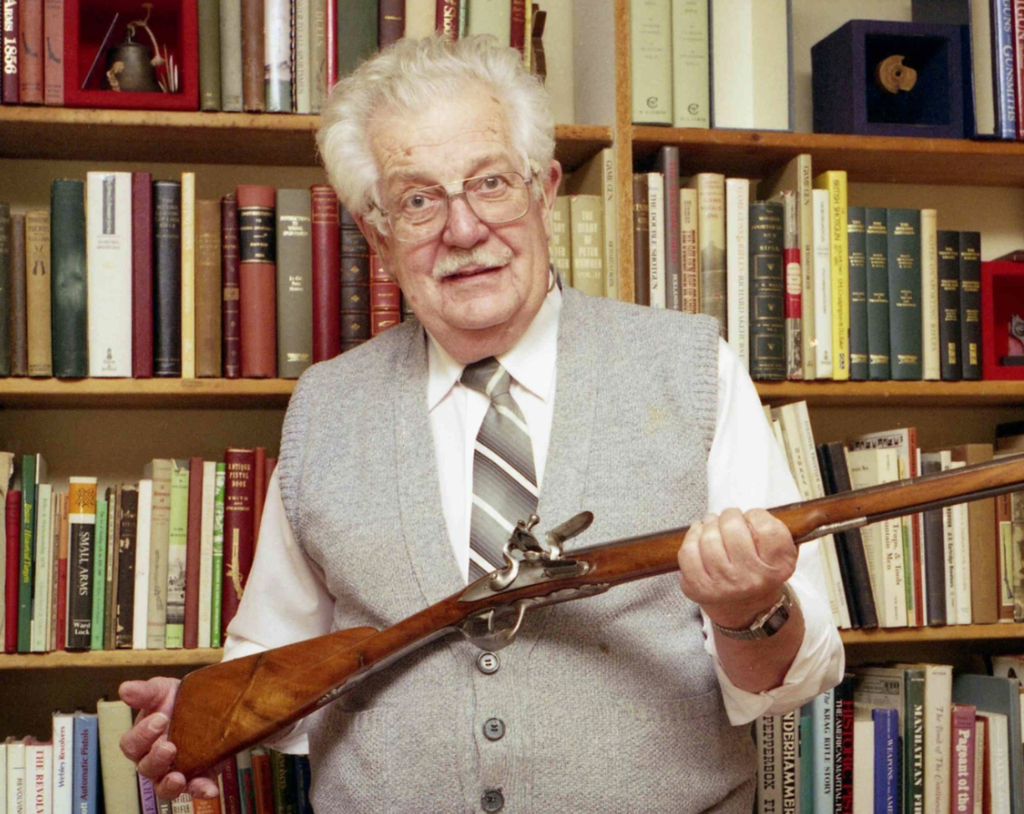
    A significant collection of historic gun lock research has gained a new audience thanks to the efforts of three firearms historians. The American Society of Arms Collectors (ASAC) has published the reconstructed gun lock catalog of the late S. James “Jim” Gooding.

    Gooding, who died in 2012, spent decades studying antique firearms, particularly their ignition systems. His work as a researcher, author, publisher, and collector made him a respected authority in the field.

    Among his interests was an extensive collection of gun locks. These mechanisms provide important evidence about the development of firearms technology, manufacturing practices, and individual gunmakers.

    Gooding photographed nearly every lock in his collection and maintained a detailed catalog of their characteristics. He intended to incorporate the material into a comprehensive history of firearms ignition systems. The collection would have formed Chapter 14 of that unfinished work.

    However, Gooding died before completing the project.

    S. James Gooding
    S. James Gooding (1930-2012)

    Fortunately, the photographs included numbers corresponding to entries in his catalog. Researchers Will Adye-White, Brian Godwin, and Matthew Schneiderman used those numbers to reunite the photographs with their original descriptions.

    Their efforts resulted in the reconstructed Jim Gooding’s Gun Lock Collection and Catalogue, which ASAC published online in 2026.

    The catalog includes detailed information about individual locks, their makers, mechanical features, and historical context.

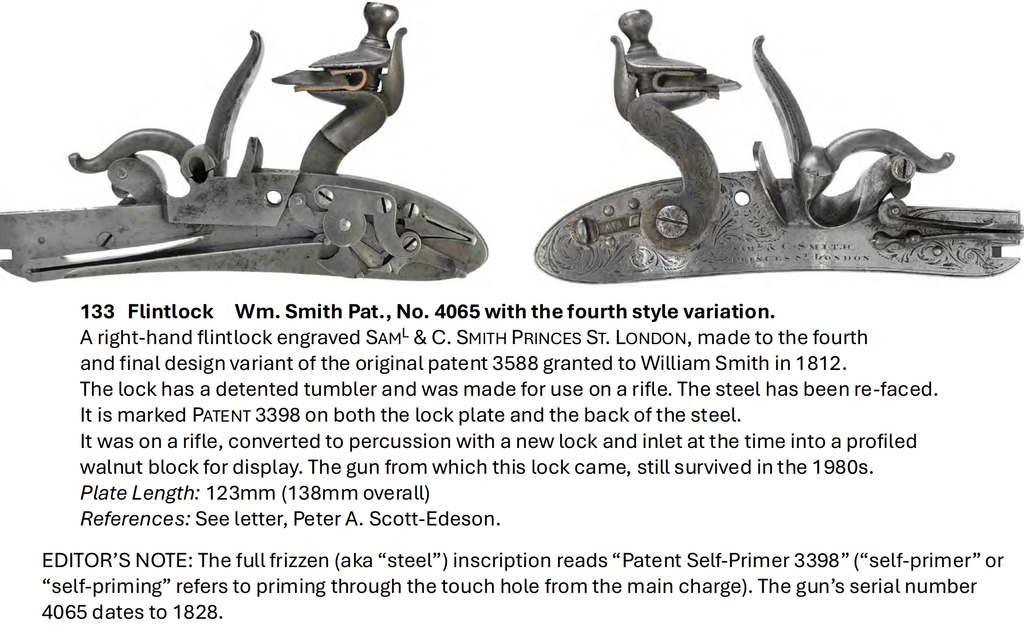
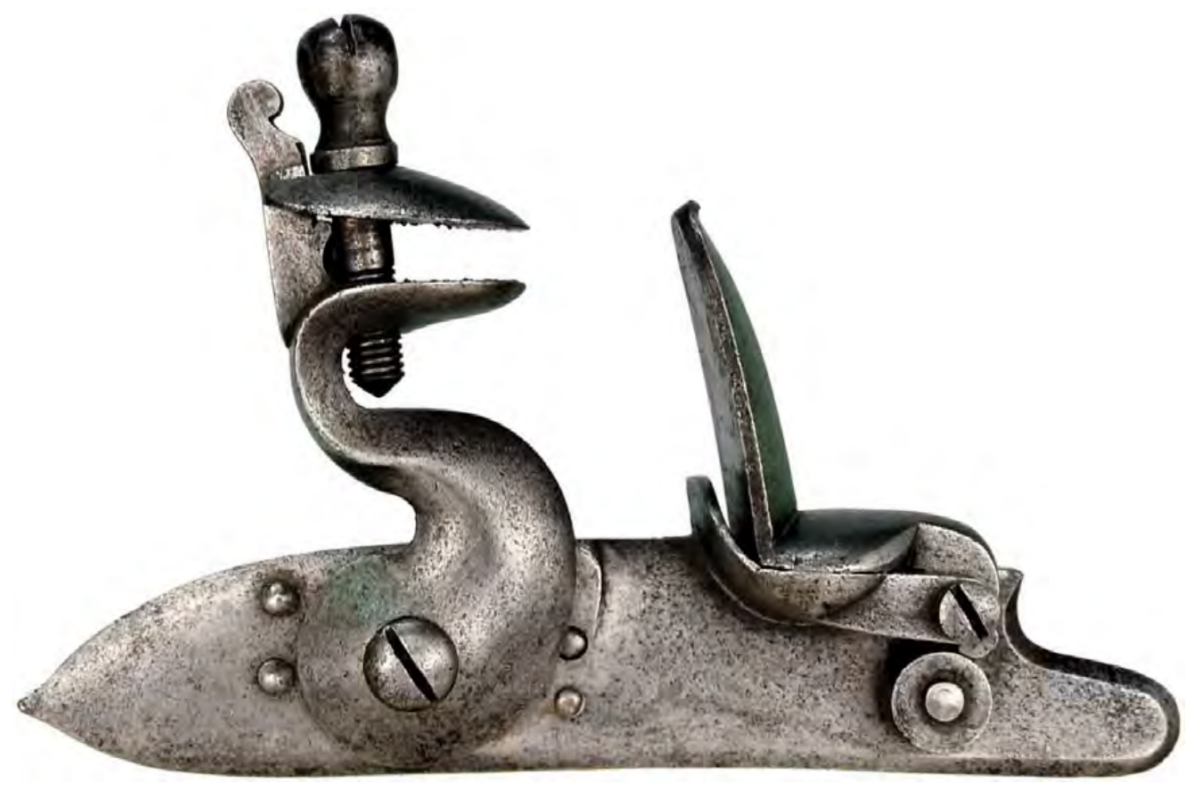
    One example is catalog number 133, a William Smith patent flintlock dating to 1828. The entry documents the lock’s markings, patent information, and the serial number of the rifle to which it was originally attached.

    flintlock excerpt
    Catalog number 133

    Such information can prove valuable when identifying detached locks or examining antique firearms whose original configurations are uncertain. Like other specialized firearms research, Gooding’s catalog demonstrates how original documentation can help collectors identify historical artifacts and better understand their significance.

    For collectors, the catalog provides an additional reference for comparing surviving examples against documented historical specimens. It also preserves information about a specialized collection that might otherwise have become difficult to reconstruct.

    The project illustrates the importance of maintaining detailed collection records. Photographs, identification numbers, and written descriptions allowed researchers to preserve Gooding’s work more than a decade after his death.

    Gooding’s research continues to benefit collectors through additional publications available from ASAC. These include his unfinished history of firearms ignition systems and his scarce reference work on early percussion primers.

    The reconstructed catalog is available to the public through ASAC’s online research library, providing collectors and historians with access to material that might otherwise have remained unpublished.

  • What Royal Armouries’ £100 Million Plans Could Mean for Collectors

    What Royal Armouries’ £100 Million Plans Could Mean for Collectors

    The Royal Armouries is planning a Leeds waterfront development with an estimated budget exceeding £100 million. For firearms collectors, the museum’s wider ambitions raise a practical question: how could redevelopment improve access to historic arms and their records?

    Director general Nat Edwards outlined the waterfront proposal in a September 28, 2026, interview with Place Yorkshire. Its centerpiece would be a 38,000-square-foot exhibition and events hall on the existing Tiltyard site.

    Edwards targeted a planning submission during the second half of 2027, followed by construction beginning in mid-2028. His estimated timetable would bring completion and fit-out by early 2031. He said the existing museum would remain open throughout the waterfront construction. These dates represent targets for the proposed development.

    The broader Armouries 700 masterplan contains proposals with more direct relevance to collectors. These include phased gallery refurbishment, redisplaying the collection, improving conservation facilities, and expanding the library and archive.

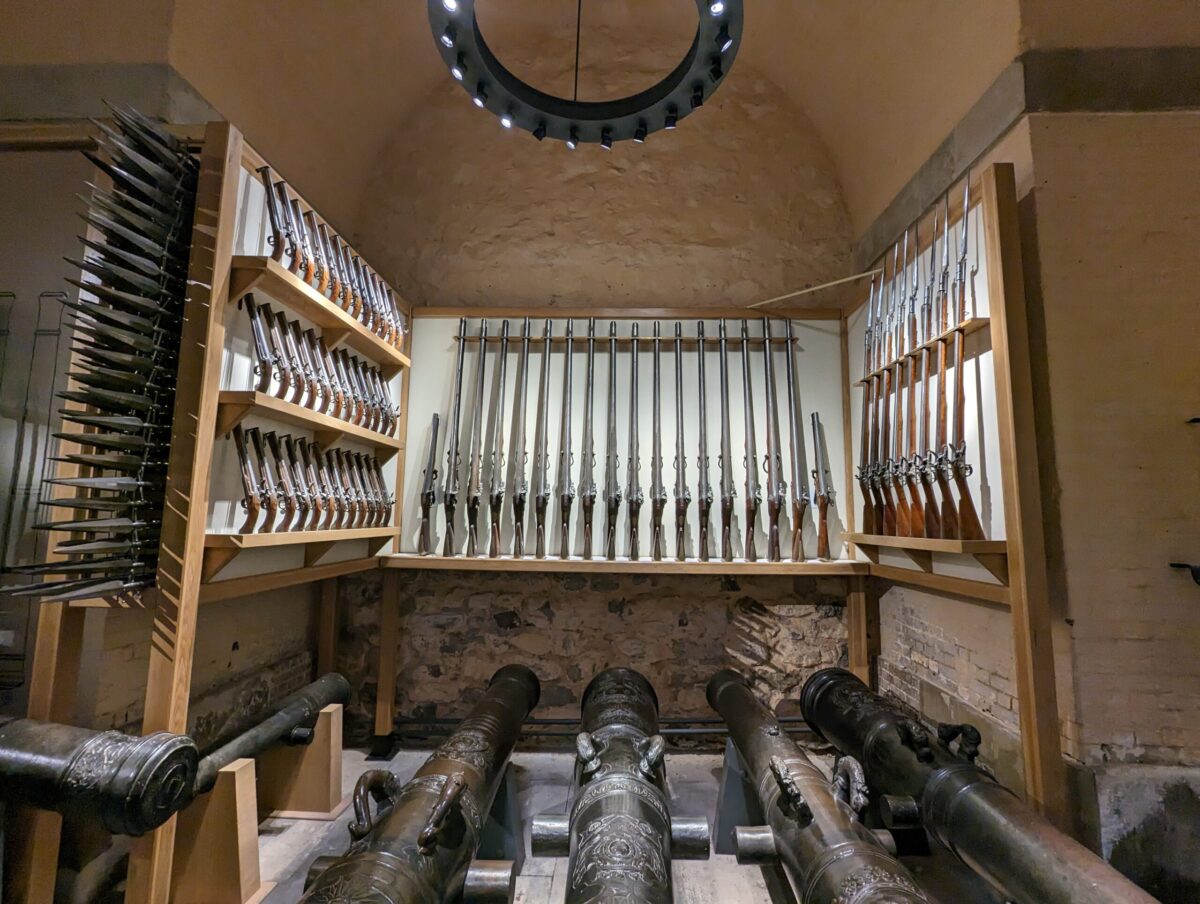
    royal armouries artist rendering
    Royal Armouries artist’s rendering

    Those improvements could give visitors fresh opportunities to examine how curators present historic firearms and explain their development. Better conservation facilities would also support the preservation of the objects themselves. One element of the wider program has already opened: the Special Exhibitions Gallery welcomed visitors in June 2025.

    The research collections provide a particularly strong reason for firearms enthusiasts to follow the project. The archives contain nearly 500,000 documents, files, bound volumes, photographs, films, and videos. Holdings include material relating to the Royal Small Arms Factory at Enfield and the Ministry of Defence Pattern Room. They also preserve company records and personal papers from arms researchers and collectors.

    For collectors studying British military firearms, these resources can help place individual models and design changes in historical context. However, only a small portion of the archive holdings currently appears in the searchable online catalog.

    The published masterplan leaves several collector questions unanswered. It does not identify which firearms will feature in redesigned displays or specify expanded research hours. It also does not promise comprehensive archive digitization. The eventual benefits will depend on how the museum delivers those details.

    Collectors planning research visits can already request library and archive appointments, currently offered Tuesday through Friday. Both services require advance booking. Library staff specifically advise visitors to wait for booking confirmation before making travel arrangements.

    A few years ago, I interviewed Jonathan Ferguson, the Keeper of Firearms and Artillery for the Royal Armouries. You can check it out here:

  • Shooter’s Bible Marks 118 Editions With New 2026 Release

    Shooter’s Bible Marks 118 Editions With New 2026 Release

    One of the firearms world’s longest-running reference books will return with a new edition later this month.

    Skyhorse Publishing will release the 118th edition of Shooter’s Bible on October 27. The new volume runs 608 pages and carries a $29.99 list price.

    The annual reference has appeared for more than 80 years. During that time, Shooter’s Bible has sold more than seven million copies. The publisher describes it as a reference guide to both current-production firearms and guns that remain on the commercial market.

    The 118th edition continues that approach. It includes specifications and information on firearms from manufacturers around the world. The book also covers ammunition, optics, and accessories.

    That scope separates Shooter’s Bible from a dedicated collector-price guide. Rather than concentrating primarily on values, the book serves as a broad snapshot of the firearms marketplace. Collectors can use older editions to track changes in manufacturers, models, specifications, and product lines over time.

    That gives the series value beyond its original purpose. A current edition can help identify a firearm or compare factory specifications. An edition from decades earlier can reveal what companies offered when a particular gun was new.

    For researchers, that historical trail can become especially useful. Catalog descriptions change. Companies disappear. Model names evolve. Specifications sometimes shift during a production run. Annual reference books can preserve those changes in ways that modern manufacturer websites do not.

    The new edition comes from editor Jay Cassell, a longtime outdoor writer and publishing veteran. His work has appeared in Field & Stream, Outdoor Life, Sports Afield, and other publications.

    Collectors should not expect Shooter’s Bible to replace specialized reference works. A Winchester researcher will still need Winchester books. A Colt collector will still need factory records and model-specific sources.

    But broad references serve another purpose. They help researchers establish context before moving into the details. They also document what the firearms industry looked like at a particular moment.

    That may prove particularly valuable decades from now. Today’s ordinary catalog entry can become tomorrow’s production-history evidence.

    After 118 editions, Shooter’s Bible has accumulated plenty of that evidence already.