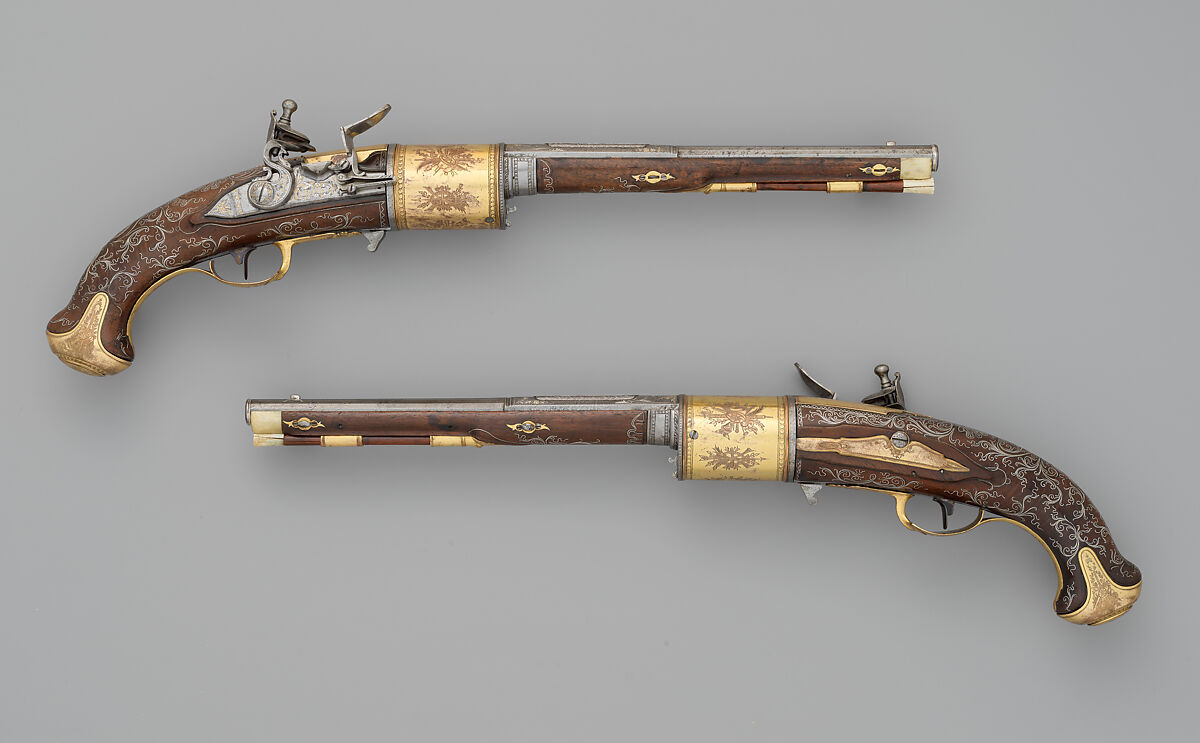
A pair of Russian flintlock revolvers dating to about 1790 has joined the Metropolitan Museum of Art’s collection through a 2026 gift from Irene Roosevelt Aitken.
Made at the Tula Arms Factory, the pistols offer a look at repeating firearms and luxury gunmaking decades before Colt’s revolvers. According to the museum’s collection record, they belonged to a matching set made for a member of the Russian imperial family during Catherine the Great’s reign between 1762 and 1796. A corresponding six-shot fowling piece survives at the State Hermitage Museum in St. Petersburg, Russia.
The pair combines gilt copper-alloy cylinders and mounts with walnut stocks decorated in silver wire. Particularly interesting to collectors are the smoothbore barrels: the museum identifies their Damascus-like appearance as etched decoration imitating pattern-welded steel as opposed to being actual pattern-welded steel. That distinction illustrates why a surface pattern warrants closer examination when identifying a firearm’s construction.
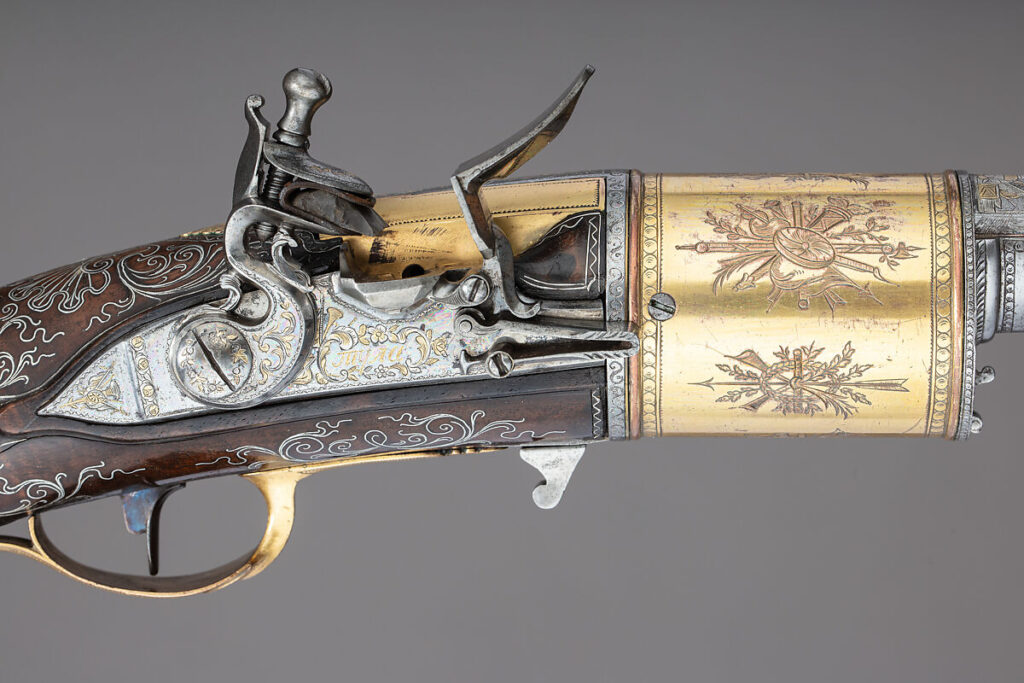
The acquisition expands an existing group of Tula arms at the Met. Its holdings also include pistols made for Grand Duke Constantine around 1801, part of a series made for Emperor Alexander I and his brothers to mark Alexander’s coronation. Each of the four brothers received five hunting arms, including a pair of pistols. The museum currently lists Constantine’s pair on view in Gallery 375 at its Fifth Avenue building.
Together, the two pairs offer collectors an opportunity to compare the factory’s approach to ornament and imperial patronage across roughly a decade.
The circa-1790 revolvers, accession numbers 2026.267.9a and b, are currently listed as not currently on view, but that could change with future exhibitions. In the meantime, their online record includes public-domain photographs for closer study.
Collectors interested in studying early ignition systems can also explore Jim Gooding’s reconstructed gun lock catalog, which brings together photographs, markings and descriptions of historic mechanisms.