I’m looking forward to joining Tom Gresham on Gun Talk Radio this Sunday, October 11, at 4:05 p.m. Eastern to talk about The Collector’s Wire!
I’ve known Tom and his son Ryan for years, and our paths have crossed a number of times through the firearms industry. I’ve been a guest on Gun Talk Radio before, and I also had the chance to interview both of them for an episode of No Lowballers, the award-winning podcast I previously hosted.
It’s always good to catch up with Tom, and I’m glad we’ll have an opportunity to talk about what’s happening in the firearms collecting community.
The Collector’s Wire is still very new, but the idea behind it is pretty straightforward. There’s a lot happening in the world of gun collecting, from club activities and collector shows to auctions, museum exhibits, books, and new historical research. Unfortunately, much of that information doesn’t get the attention it deserves.
My hope is that The Collector’s Wire can help bring more of those stories together in one place and make it easier for collectors to stay informed about what’s happening in their hobby.
I’m looking forward to discussing the project with Tom and hopefully introducing a few more people to what we’re doing.
Firearms collectors have never lacked information.
The problem is finding it.
For example, auction houses announce important consignments on their own websites. Museums reveal new acquisitions through press releases and newsletters. Collector organizations publish research for their members. New books appear with little fanfare. Events get announced months in advance and then disappear into social feeds.
All of that information matters to collectors, but no single place consistently brings it together.
That is why I created The Collector’s Wire.
The Collector’s Wire is a new publication devoted to news, auctions, research, events, and intelligence for firearms collectors.
The goal is simple: make it easier to stay informed.
Coverage will include major auction consignments and results, museum acquisitions and exhibitions, collector organizations, new books and research, military surplus arrivals, important industry developments, upcoming events, and other information that affects the collecting community.
Some stories will be substantial. Others may only need a few hundred words. The important thing is that they are worth knowing.
The site launches with coverage ranging from a $270,600 MKb.42(H) auction result to Beretta’s 500th anniversary. Other stories examine Revolutionary War arms conservation at the Smithsonian, newly available military-surplus Walther P38 pistols, collector organizations, upcoming shows, and new firearms reference books.
That mix is intentional.
The Collector’s Wire is not meant to become another general firearms website. Its focus is narrower: the people, objects, institutions, markets, and research that shape firearms collecting.
It will also depend on the collecting community.
Auction houses, museums, authors, researchers, collector clubs, dealers, and individual collectors can submit news and announcements directly through the site. Not every submission will become a story, but I want The Collector’s Wire to become a place where worthwhile collector news has somewhere to go.
Subscribers will also receive regular email roundups through The Collector’s Wire newsletter. The publication is produced by High Caliber History LLC, but it has its own editorial mission and identity.
There are a lot of stories in the firearms collecting world.
Dealers from across the country will bring antique firearms, uniforms, swords, medals, daggers, photographs, flags, and related material.
Most of the objects date from the Civil War through World War II. That makes the show especially relevant for collectors who focus on military firearms and their associated material culture.
OVMS describes itself as one of the oldest and largest militaria collector organizations in the world. The group currently reports more than 2,000 members. Its stated mission centers on the study and collecting of historic military artifacts.
Firearms form an important part of that mission. A military rifle or handgun often becomes more useful to researchers when studied alongside uniforms, photographs, documents, field equipment, and unit-marked objects.
Shows like Wilmington can bring those categories together under one roof.
The variety also gives collectors a chance to study items they may rarely encounter locally. Civil War arms can appear beside World War I pistols, World War II rifles, edged weapons, medals, and bring-back souvenirs.
Provenance remains a major concern in every category.
Collectors should still examine markings, originality, restoration, and documentation carefully before buying. That becomes especially important with historically attributed pieces.
Public admission begins at noon Friday and runs until 5 p.m. Saturday hours run from 9 a.m. to 3 p.m.
One-day admission costs $7. A two-day pass costs $10.
OVMS members may enter beginning at 10 a.m. Friday. Membership is available at the door.
The organization also publishes The Military Historian and maintains archives of earlier issues for collectors and researchers.
The Wilmington show follows OVMS’s September MAX Show in York, Pennsylvania.
Its next major event will be the 2027 Show of Shows in Louisville, Kentucky. That gathering typically operates on a much larger scale.
For collectors who do not want to wait until February, Wilmington offers a more immediate opportunity. The combination of historic arms, military antiques, and specialist dealers makes it more than a general gun show. It functions as a focused marketplace for objects tied directly to military history.
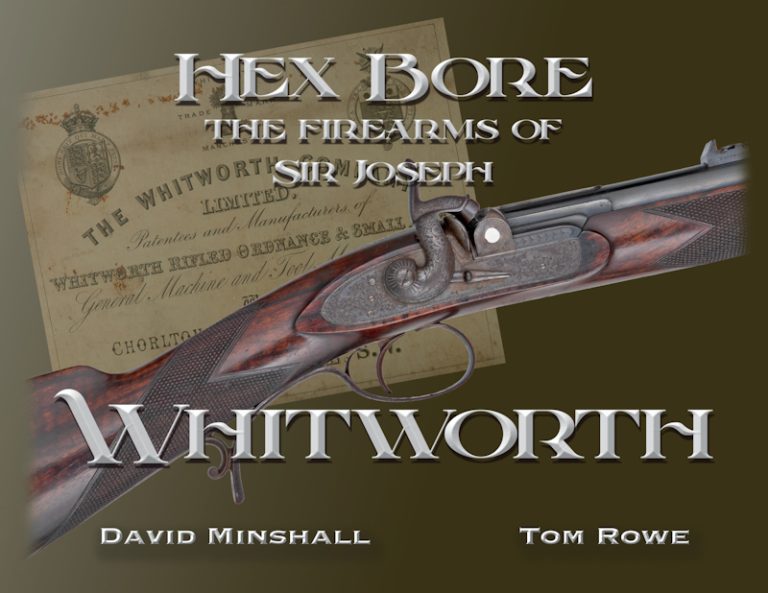
The 380-page hardcover traces the development of Whitworth’s distinctive hexagonally bored muzzle-loading rifles. More importantly for collectors, the authors built their study around a database of 750 known examples.
That gives the book a strong foundation in surviving firearms rather than historical documents alone.
Joseph Whitworth approached rifle design through precision engineering and systematic experimentation. His work demonstrated the accuracy possible from carefully manufactured rifles firing elongated projectiles.
The results influenced rifle development far beyond Whitworth’s own production.
The British military extensively tested the Whitworth rifle but never adopted it as a standard service arm. Civilian target shooters proved more receptive.
Queen Victoria famously fired a Whitworth rifle when she opened the National Rifle Association’s inaugural annual meeting at Wimbledon in 1860.
The rifle soon developed a reputation among serious long-range competitors.
Minshall and Rowe follow that development across several distinct firearm types. The book examines military rifles, military target rifles, match rifles, sporting rifles, double rifles, and related variations. It also explores firearms made by other gunmakers under license from Whitworth.
American collectors will likely find the Civil War material particularly interesting. Confederate sharpshooters used Whitworth rifles during the war, creating a reputation that still shapes collector interest today. The authors also examine the rifle’s lesser-known use in New Zealand.
Accessories receive substantial attention as well.
The book covers ammunition and equipment associated with the rifles, including the Davidson telescopic sight. Surviving accessories can prove especially important when documenting unusual or high-condition examples.
Access to private collections allowed the authors to illustrate the study with extensive color photography. That combination of archival research, production analysis, and examination of surviving guns gives the book considerable potential as a collector reference.
The database of 750 rifles may prove its most useful contribution. Serial numbers and surviving examples can help researchers understand production patterns that factory documents alone may not reveal. They can also help collectors place individual rifles within the larger history of Whitworth production.
For collectors of British military rifles, Civil War arms, or long-range target rifles, the book fills a very specialized niche. That specialization may also be its greatest strength.
Research Press currently lists the hardcover at $150. You can order it here.
The price may seem steep on the surface, but it’s important to remember that other specialized firearms books like these are usually priced similarly – and they’ll cost even more on the secondary market once they go out of print.
The gathering will take place at Spooky Nook at Champion Mill, offering 90,000 square feet of event space for the association’s members and invited guests.
OGCA meetings are not public gun shows. The organization limits admission to members and their invited guests. That distinction helps preserve the collector-focused atmosphere that has defined the association for decades.
The November meeting will run from 8:30 a.m. to 5 p.m. Saturday. Sunday hours run from 8:30 a.m. to 2 p.m.
OGCA regularly fills its meetings with 600 to 700 tables of firearms and related material. Thousands of collectors attend its larger gatherings throughout the year.
The association traces its history to 1937. Since then, OGCA has grown into one of the nation’s largest firearms collector organizations. It now reports membership exceeding 15,000.
The group places a strong emphasis on historical arms and collector education. Members regularly include authors, researchers, advanced collectors, and specialists in individual manufacturers or periods.
That concentration of knowledge gives the meetings significance beyond buying and selling.
Collectors can compare firearms, examine variations, discuss provenance, and exchange research in person. Those opportunities become especially valuable when studying rare guns that seldom appear in reference books.
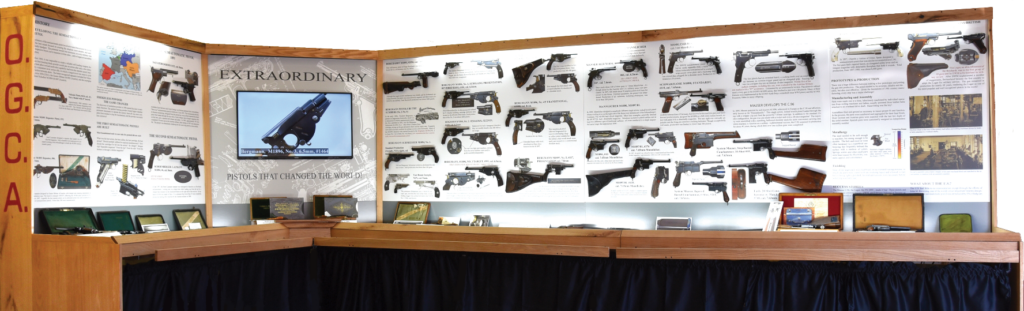
Displays also play an important role in OGCA culture. Past meetings have featured large educational exhibits built around military firearms, sporting arms, manufacturers, and other specialized collecting subjects. The association also holds an annual competitive display show.
The November gathering comes after OGCA’s September meeting in Wellington, Ohio. It also marks the group’s final scheduled meeting before its 2027 calendar begins.
OGCA will return in February 2027 at the Ohio State Expo Center in Columbus. Additional meetings will follow in Wellington and Hamilton.
For collectors interested in attending the November meeting, membership matters. OGCA does not sell general public admission. Members may bring invited guests under the association’s rules, while prospective members can apply through the organization.
That closed format remains unusual in an era dominated by public gun shows and online sales. It also helps explain OGCA’s longevity.
For nearly 90 years, the association has built its meetings around collectors gathering with other collectors. The November meeting will continue that tradition on a scale few collector organizations can match.
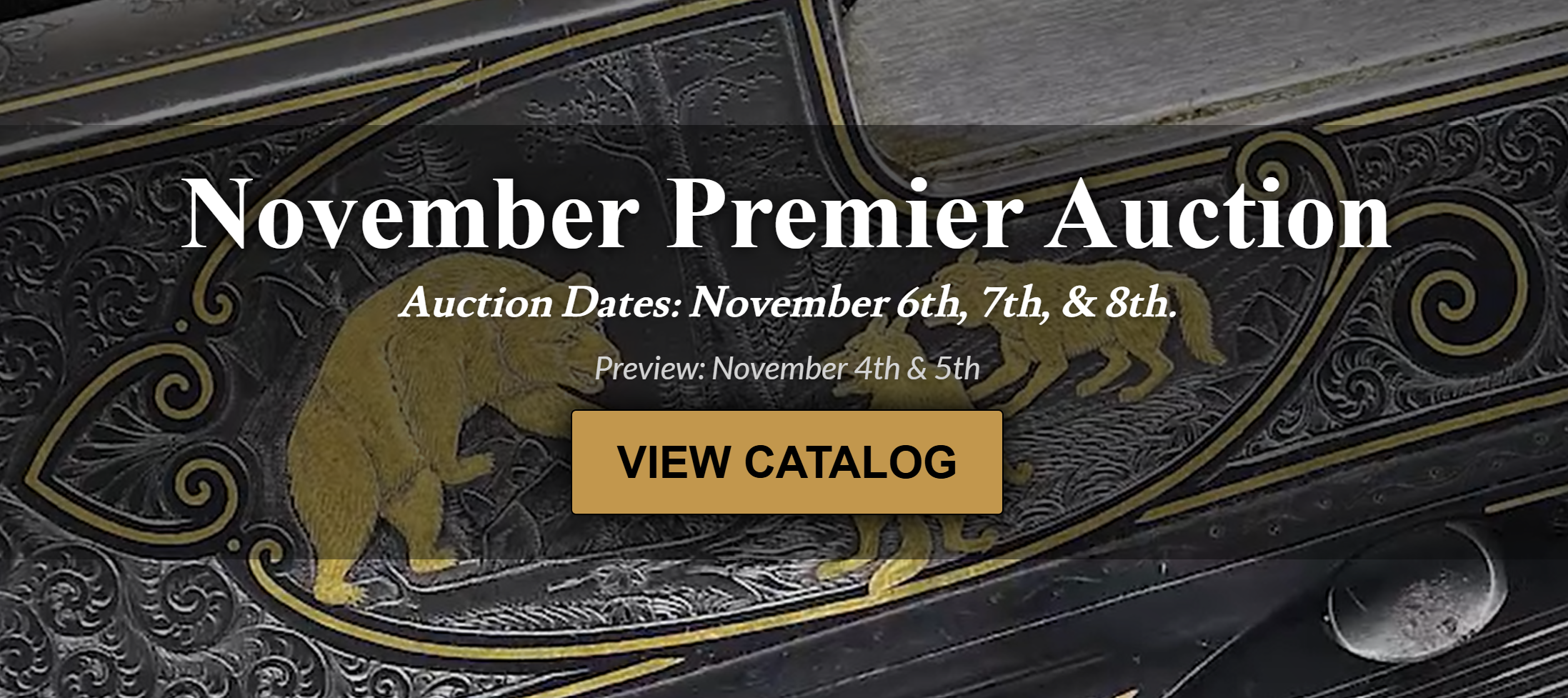
The three-day sale spans antique arms, military firearms, sporting guns, edged weapons, ammunition, and accessories. Its first session places particular emphasis on transferable machine guns and unusual military arms.
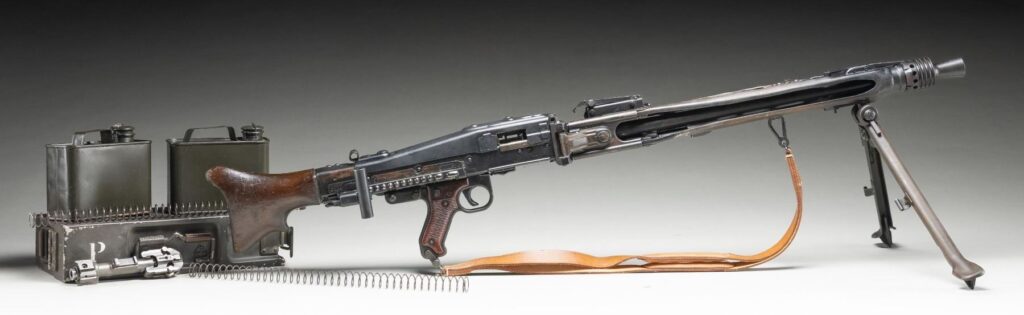
A Gustloff-Werke MG42 sits near the front of the catalog. The World War II German machine gun carries a $50,000–$75,000 estimate. Poulin catalogs the 8mm Mauser gun with accessories and identifies it as a Curio & Relic example.
Collectors will also find several Thompson submachine guns.
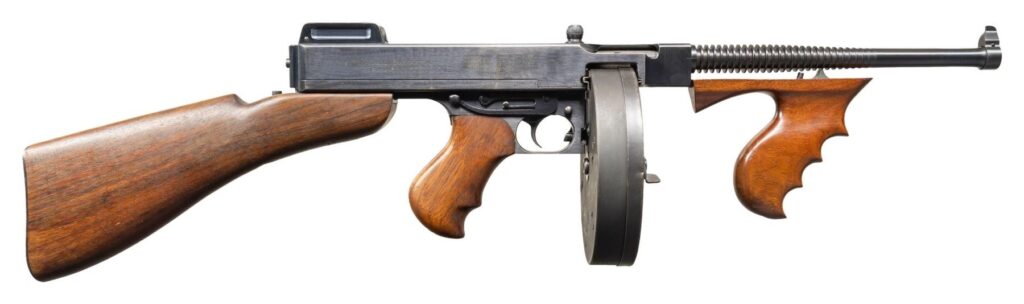
One of the most interesting is a Colt Model 1921AC Thompson, serial number 6662. The gun carries markings for the Salt Lake City Corporation and comes with a case and accessories. Poulin estimates it at $35,000–$50,000.
Several later Thompsons follow it in the catalog. They include Savage M1 examples and Auto-Ordnance Model 1928 and M1A1 guns. Estimates generally range from the low $20,000s into the mid-$30,000s.
Another group should interest collectors of Colt and early AR-platform development.
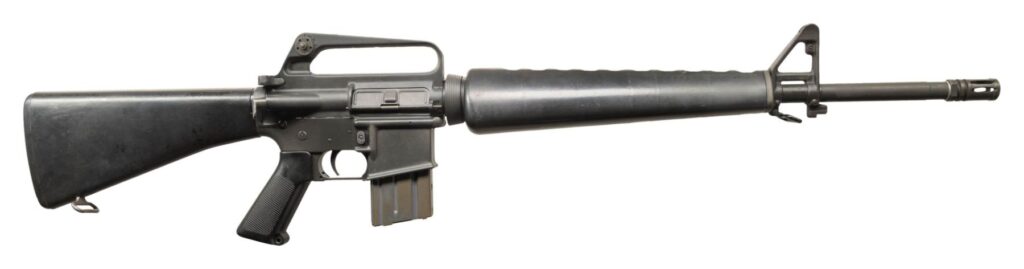
Poulin will sell an unusual Colt transitional developmental light machine gun from the collection of former Colt executive John Keosayian. The auction house describes the .223-caliber firearm as a predecessor to the M16. It carries serial number XM20982 and a $50,000–$65,000 estimate.
A second Colt light machine gun from the Keosayian collection carries a higher estimate. Poulin lists that AR-15/M16-pattern gun at $50,000–$70,000.
The catalog also includes a transferable SACO-Lowell Maremont M60. Poulin estimates the 7.62 NATO machine gun at $65,000–$80,000.
Collectors looking beyond automatic arms will find a large Winchester grouping on the second day.
The November 7 session opens with an assortment of Winchester Model 70 rifles. Early lots include Super Grades, pre-64 rifles, African models, and several less-common chamberings.
One pre-64 Model 70 Featherweight stands out in .358 Winchester. Poulin notes that Winchester produced approximately 2,000 examples during 1955 and 1956. The auction house estimates the rifle at $3,000–$4,000.
Other Model 70 offerings include rifles in .375 H&H Magnum, .300 H&H Magnum, .257 Roberts, .220 Swift, and .22 Hornet. The catalog also includes Model 52 target and sporting rifles.
Poulin has scheduled previews for November 4 and 5. Each auction session begins at 10 a.m. Eastern. The company will accept live, absentee, telephone, and online bids.
The breadth of the catalog gives collectors several markets to watch. The Class III material may generate the largest prices. The developmental Colts offer a different kind of rarity. Meanwhile, the Winchester grouping gives traditional sporting-arms collectors plenty to study.
For collectors tracking values, the sale should provide useful results across several very different categories.
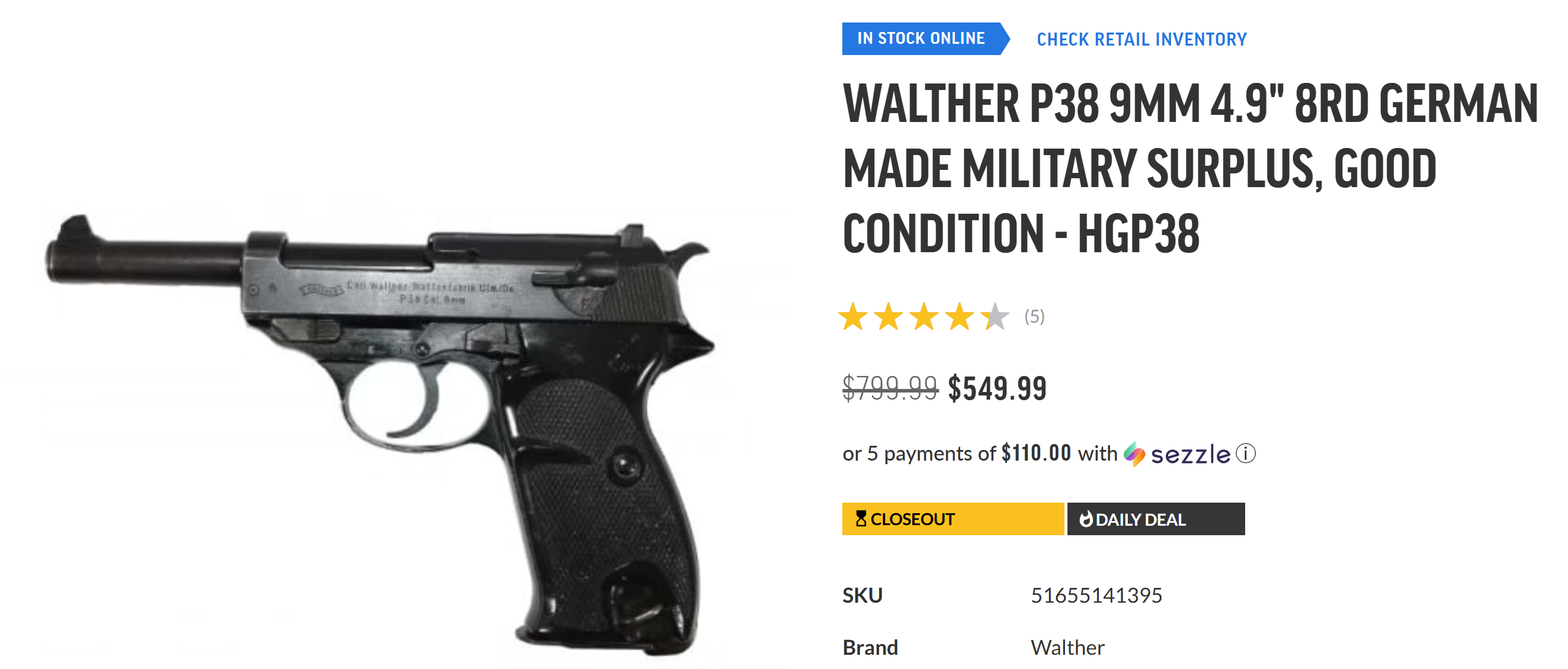
A fresh batch of German-made Walther P38 pistols has surfaced on the U.S. surplus market.
Palmetto State Armory currently lists the postwar 9mm pistols for $549.99. The retailer marks them as a closeout and daily deal. They remain listed as in stock online at the time of this posting.
The pistols qualify as Curio & Relic firearms and carry an importer grade of NRA surplus “good” condition. PSA says many examples may actually reach very-good condition.
Collectors should note one important distinction:
These are not World War II-production steel-frame P38s.
Walther resumed P38-family production in West Germany after the war. The company began supplying the newly created Bundeswehr in 1957. Unlike their wartime predecessors, the new pistols used lightweight aluminum frames. Walther later used the P1 designation for the German military version.
PSA says most pistols in this batch date from the early 1960s. Some examples reportedly carry dates from the early 1970s. The retailer describes them as aluminum-frame P38s produced at Walther’s Ulm facility.
That date range could create considerable variation within the shipment.
Walther continued modifying the postwar design during its service life. Later aluminum frames received additional reinforcement, most visibly through a transverse hexagonal steel bolt above the trigger guard beginning in the mid-1970s. Earlier examples lack that feature.
That means collectors should not assume every pistol in the shipment represents exactly the same variation.
PSA lists each pistol with a 4.9-inch barrel and one eight-round magazine. The guns retain the familiar 9mm chambering and double-action/single-action operating system associated with the P38 family.
The retailer tells buyers to expect normal finish wear and light scratches. However, PSA says it has not observed rust among the examples examined. It also describes the bores as generally good.
The P38 occupies an important place in military handgun development.
Germany adopted the original design before World War II as a replacement for the Luger P08. Walther gave it a double-action/single-action trigger system, an eight-round magazine, and a locking-block action. Mauser and Spreewerk eventually joined Walther in wartime production. More than a million examples were produced during the war.
West Germany then gave the basic design a second military career.
That history makes these newly available pistols interesting even without a wartime connection. They represent the Cold War continuation of one of Germany’s most important military handgun designs.
Their appearance also highlights a larger collecting trend.
Large quantities of inexpensive military surplus have largely disappeared from the American market. When sizeable groups of C&R-eligible firearms surface today, they increasingly qualify as collector news in their own right.
At $549.99, these postwar Walthers offer a useful snapshot of that changing surplus market.
One of the firearms world’s longest-running reference books will return with a new edition later this month.
Skyhorse Publishing will release the 118th edition of Shooter’s Bible on October 27. The new volume runs 608 pages and carries a $29.99 list price.
The annual reference has appeared for more than 80 years. During that time, Shooter’s Bible has sold more than seven million copies. The publisher describes it as a reference guide to both current-production firearms and guns that remain on the commercial market.
The 118th edition continues that approach. It includes specifications and information on firearms from manufacturers around the world. The book also covers ammunition, optics, and accessories.
That scope separates Shooter’s Bible from a dedicated collector-price guide. Rather than concentrating primarily on values, the book serves as a broad snapshot of the firearms marketplace. Collectors can use older editions to track changes in manufacturers, models, specifications, and product lines over time.
That gives the series value beyond its original purpose. A current edition can help identify a firearm or compare factory specifications. An edition from decades earlier can reveal what companies offered when a particular gun was new.
For researchers, that historical trail can become especially useful. Catalog descriptions change. Companies disappear. Model names evolve. Specifications sometimes shift during a production run. Annual reference books can preserve those changes in ways that modern manufacturer websites do not.
The new edition comes from editor Jay Cassell, a longtime outdoor writer and publishing veteran. His work has appeared in Field & Stream, Outdoor Life, Sports Afield, and other publications.
Collectors should not expect Shooter’s Bible to replace specialized reference works. A Winchester researcher will still need Winchester books. A Colt collector will still need factory records and model-specific sources.
But broad references serve another purpose. They help researchers establish context before moving into the details. They also document what the firearms industry looked like at a particular moment.
That may prove particularly valuable decades from now. Today’s ordinary catalog entry can become tomorrow’s production-history evidence.
After 118 editions, Shooter’s Bible has accumulated plenty of that evidence already.
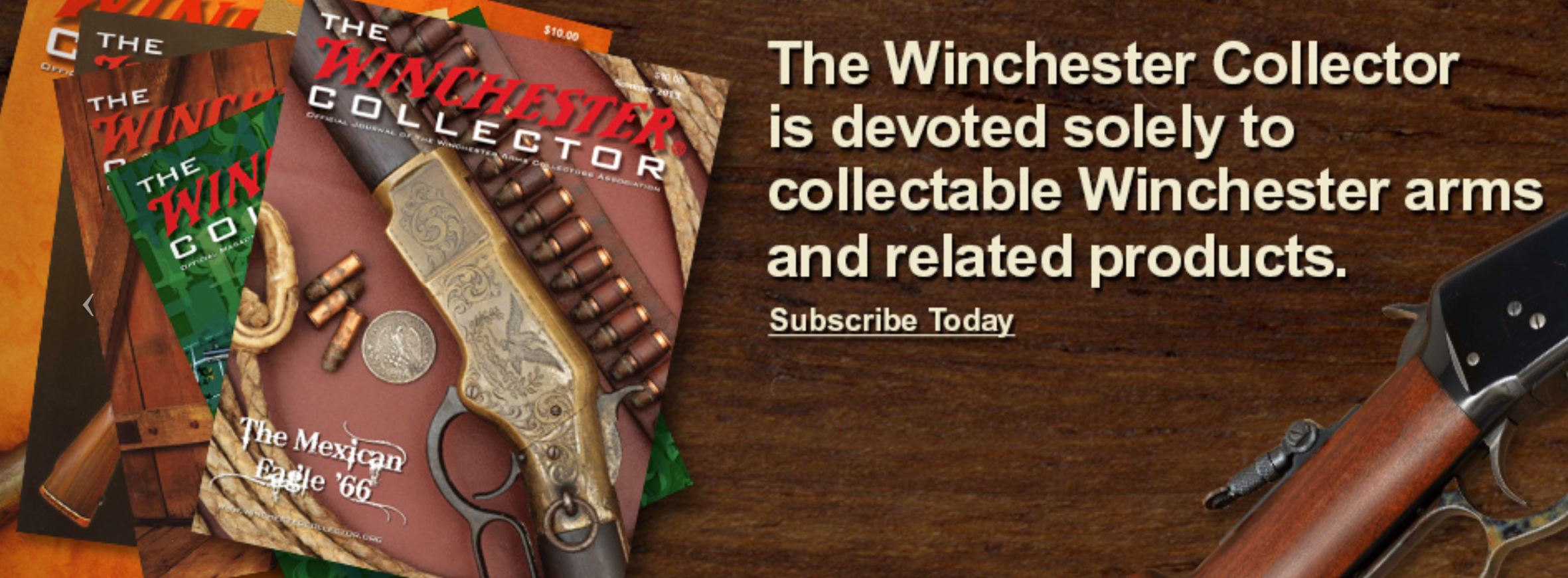
The Winchester Arms Collectors Association has released the Fall 2026 issue of The Winchester Collector.
The quarterly magazine focuses on Winchester firearms, company history, related products, and collector research. WACA publishes four issues each year for its worldwide membership of more than 3,000 collectors.
The new issue contains four feature articles covering subjects well beyond firearm identification and values.
Jennifer and Gary Gole examine Winchester Sportsman’s Headquarters clothing. Their article explores another side of the Winchester brand that collectors sometimes overlook. Winchester sold much more than firearms and ammunition during its long history.
Bert Hartman turns to the Winchester Model 55 for another feature. Winchester introduced the lever-action Model 55 during the 1920s as a variation on the Model 1894 platform. Today, collectors often encounter far fewer Model 55s than their much more common Model 94 relatives.
John Dunlap contributes “The Deerstalker’s Heirloom.” Pete Hynard rounds out the issue with an article on rifling and rate of twist.
That range of subjects reflects one of the strongest functions of specialized collector organizations.
Major reference books can provide broad histories and identification information. Collector associations often go much deeper. Their members study production variations, markings, accessories, advertising, factory records, and obscure models that may never justify a standalone book. WACA has followed that model for decades.
The magazine also gives researchers a continuing archive of specialized Winchester information.
Earlier 2026 issues covered subjects ranging from Model 1873 rimfire rifles to pre-1964 Model 70 “Gopher Specials.” The Summer issue included research on the Model 75, Winchester recognition pins, Model 1300 manufacture dates, and the Model 1886 in .33 WCF.
WACA makes selected articles available publicly through its website. Members receive access to the complete current issue and the organization’s archive. The association also sells individual hard copies of the Fall 2026 issue for $7 to members and $10 to non-members.
The organization’s work extends beyond publishing. WACA sponsors collector shows, educational displays, research resources, and an online forum. Its annual Cody Show draws hundreds of trade and display tables. The 2026 show sold out before opening in July.
For Winchester collectors, publications like The Winchester Collector serve another important purpose. They preserve research that might otherwise remain in private notes, collections, or conversations between longtime collectors.
That accumulated knowledge becomes more valuable as original records disappear and experienced collectors leave the hobby.
The Fall 2026 issue continues that work with subjects ranging from lever actions to clothing. It also demonstrates how much Winchester history exists beyond the guns themselves.